
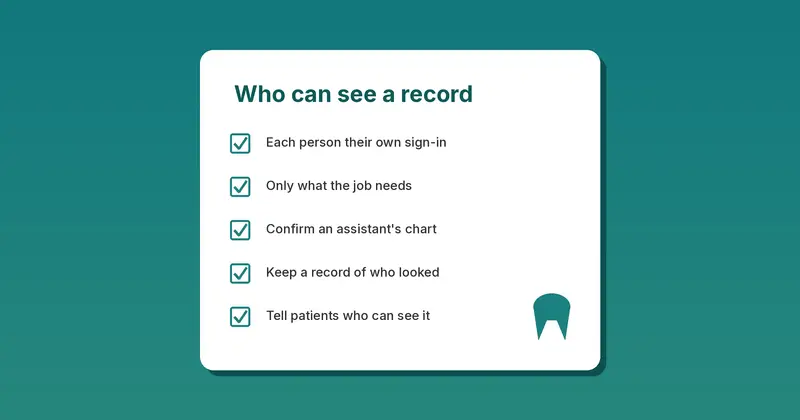
A patient's chart is not something everyone in the clinic needs to open. This article covers who should see what, how to give each person their own sign-in, and how to keep a record of who looked. Those habits help a clinic meet the Data Privacy Act of 2012, Republic Act No. 10173. The Data Privacy Act guide covers what the Act asks of a clinic as a whole.
This is information, not legal advice. For your own clinic's case, ask your lawyer.
Why this matters
Health information is sensitive personal information under Section 3(l) of the Act. Your clinic is the personal information controller: it is responsible for how staff use the records, even when the records sit in software.
Section 20 requires reasonable and appropriate organizational, physical and technical measures to protect personal information against unlawful access and disclosure. Section 20(e) says employees, agents or representatives who handle personal information must keep it under strict confidentiality, and that duty continues after they leave their job.
The rest of this article is about the practical habits that support those duties: who is allowed in, what they can see, and how you can tell who looked.
Give each person their own sign-in
Do not share the dentist's sign-in with the assistant, the secretary or a reliever. A shared sign-in makes it hard to know who opened a record, and hard to cut off access on the day someone leaves.
The Act does not use the words "unique sign-in." Each person their own sign-in is a practical way to meet the duty in Section 20, because you can turn one person's access off without changing everyone else's.
When someone leaves, turn off their sign-in that day. Collect any printed copies they held. Section 20(e) still requires them to keep what they learned confidential after they leave.
On paper, a folder on the front desk is open to whoever walks past it. In software, access can be limited, but only if each person signs in as themselves.
Only what the job needs
Section 11 of the Act requires processing to follow transparency, legitimate purpose and proportionality. Personal information must be adequate and not excessive in relation to the purposes for which it is collected and processed (Section 11(d)).
In a clinic, that usually means:
- The dentist who is treating the patient needs the full record: the chart, medical history, X-rays, the plan and what was billed.
- An assistant who charts beside the chair needs the chart and the medical history. They may not need payments or the clinic's collections.
- The secretary or receptionist often needs to book, confirm visits and take payment. They may not need to open the full chart.
- A reliever dentist needs the records of the patients they will treat, for the days they are there.
These are examples, not a rule for every clinic. You decide what each job needs, and you can change it. In dental clinic software for the Philippines such as Dientecitos, the owner chooses what each person can see and do. Your assistant can chart, and you confirm. Money and fees stay with the owner unless you share them.
A record of who looked
Section 16(c) of the Act gives a patient the right, upon demand, to reasonable access to certain facts about their personal information, including the date it was last accessed and modified (Section 16(c)(7)). A log of who opened or changed a record, and when, is how you can answer that.
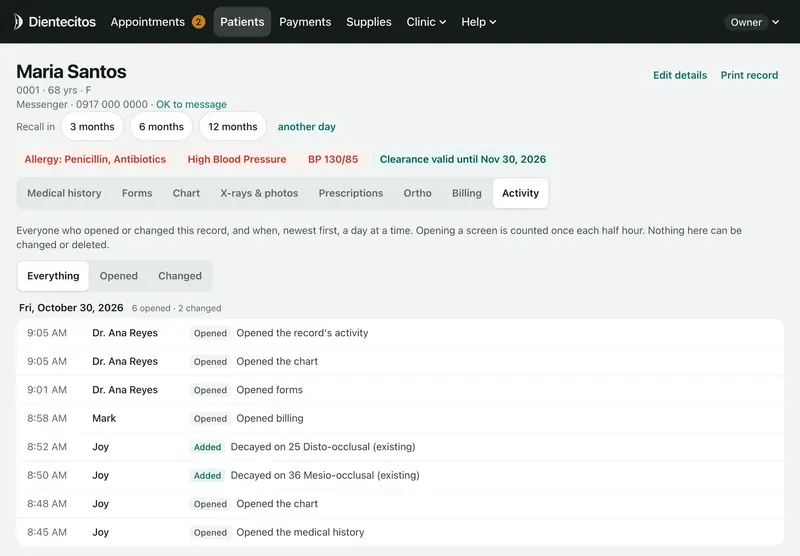
In Dientecitos, the Activity tab shows who opened or changed each record, and when. You can print it if a patient asks. Nothing in that list can be changed or deleted. The screenshot above is from the demo clinic, with made-up names.
If two people share a sign-in, the log cannot tell you which of them looked.
Tell patients who can see their record
Section 16(b) says you must tell a patient, before their information is entered or at the next practical opportunity, certain facts about the processing, including the recipients or classes of recipients to whom the information is or may be disclosed (Section 16(b)(4)).
A privacy notice at the front desk and on your booking page is the usual way to do this. It can name the classes of people in the clinic who may see a record, such as the treating dentist, the assistant at the chair, and the staff who book and bill. The Data Privacy Act guide covers the notice, the data protection officer and registration with the National Privacy Commission. Dientecitos does not write your notice or register your clinic.
Dientecitos is in pilot with several clinics in the Philippines. Try the access settings and the Activity tab with a made-up patient first. Dientecitos has a 30-day free trial, no card.
A short checklist
The questions above, in one list
- Does each person have their own sign-in, and is it turned off on the day they leave?
- Does each person see only what their job needs?
- If an assistant charts, does the dentist confirm it?
- Can you show who opened or changed a record, and when, if a patient asks?
- Does your privacy notice say who in the clinic may see a record?