
HMO accreditation is how a dental clinic in the Philippines gets on one HMO's list and is paid for covered care. This article covers what to settle before you sign, what to check on the day of the visit, and how to keep the letter of authorization, the claim, the invoice and the tax form together afterward.
This is information, not legal or tax advice. For your own clinic's case, ask your accountant or your lawyer.
A contract with one HMO, not a permit
Accreditation puts your clinic on that HMO's list of clinics. It is that HMO's contract with you. It is not a mayor's permit, not a PRC license, and not a license from the Insurance Commission.
Executive Order No. 192 (2015) transferred regulation and supervision of health maintenance organizations from the Department of Health to the Insurance Commission. Section 1 gives the Commission jurisdiction over the establishment, operations and financial activities of HMOs. Section 2, following DOH Administrative Order No. 34 (s. 1994), describes an HMO as a juridical entity legally organized to provide or arrange pre-agreed health care services to its enrolled members for a fixed pre-paid fee for a specified period of time. Section 5 requires the HMO to hold a License to Operate from the Commission. That license belongs to the HMO. It does not accredit your clinic.
Section 10 of the same order leaves the practice of the medical profession, medical procedures and standards, and health facilities with the Department of Health. Your clinic's own permits stay as they are. The list is in permits and requirements for starting a dental clinic.
PhilHealth is not an HMO. Accreditation with PhilHealth sits under the National Health Insurance Act, Republic Act No. 7875, as amended, and the Universal Health Care Act, Republic Act No. 11223. A contract with a private HMO does not make the clinic PhilHealth-accredited. PhilHealth accreditation does not put the clinic on a private HMO's list.
Each HMO keeps its own list. Accreditation with one tells you nothing about the next. Start with the cards your own patients already bring, and apply to those HMOs. Ask each one for its current checklist. Do not work from a copy of what a colleague filed years ago.
Read the fee schedule before you sign
The contract is where the money is set. Read the fee schedule next to your own fees before anyone signs.
Look for answers to these questions:
- Which services does the plan pay, and which does the patient pay the clinic?
- Which services need a letter of authorization (an LOA) before you start, and which does the card cover without one?
- What does the HMO pay for each service, next to what you charge a patient who pays the clinic?
- When do they pay, what can they deduct, and what happens if a claim is incomplete?
- Can the schedule change later, and how will they tell you?
If a figure is not written in the contract, do not treat it as promised. A spoken "we usually pay within the month" is not the contract.
A patient who is also a senior citizen or a person with disability has a discount under a separate law. The guide on senior citizen and PWD discounts explains that discount. Do not assume the HMO fee schedule already removed it. Ask your accountant how to show it on the invoice to the HMO, and on any amount the patient still pays.
On the day of the visit
Check the card and the LOA before the patient is in the chair.
- Match the name on the card to the patient. Read the member number and the validity date. An expired card is a reason to call the HMO before you start.
- If that service needs an LOA, wait until you have it. Write the LOA number on the visit. A procedure the LOA does not list is not covered until the HMO says it is.
- Chart what you did. The claim should match the chart, the tooth and the LOA.
- Before you start, tell the patient about anything the plan does not cover. If your clinic collects that part from the patient, say so then. Do not promise that the HMO will pay it.
In dental clinic software for the Philippines such as Dientecitos, the HMO card number and its validity sit at the top of the record, and the card is flagged when it has expired. You can find a patient by the card number. Try this with a made-up patient first. Dientecitos has a 30-day free trial, no card.
After the visit: invoice, claim, and Form 2307
The visit is done. The HMO still has to be billed, and the payment still has to be matched to that visit.
The paper the HMO needs for the sale is an invoice from your BIR-registered booklet, with the HMO's name, address and TIN. A statement you print for the claim is a supporting document. It is not the invoice. The guide on BIR invoices covers what the invoice must show, and why a statement carries the line that it is not valid for a claim of input tax.
Dientecitos does not print BIR invoices. You keep using your booklets. It records the invoice number with the payment, and it can print the HMO statement for the claim. With HMO claims turned on, you track each claim for a visit, print that statement, and record what was paid and what was withheld. Claims waiting over 45 days are flagged. That flag is a reminder in the software. The period that binds the HMO is the one in your contract, which may be different. Follow up from the contract, not from the flag by itself.
When the HMO pays, match the amount to the claim before you treat it as collected. Part of what they owe may have been withheld as tax. Ask for BIR Form 2307, the Certificate of Creditable Tax Withheld at Source, for that withholding. The rate depends on your clinic's own registration. It is not the same percentage for every dentist. Give each 2307 to your accountant. Do not copy a rate from a post, or from the clinic next door.
HMO tools are included in every plan. Current plans are at dientecitos.app/pricing.
What you send the HMO is still the patient's data
A member number, together with what you did today, is information about the patient's health. Health information is sensitive personal information under Section 3(l) of the Data Privacy Act of 2012, Republic Act No. 10173. The Data Privacy Act guide covers what that means for a clinic.
Section 13 prohibits processing of sensitive personal information except in the cases it lists. Two that clinics look at are the patient's consent, specific to the purpose and given before the processing (Section 13(a)), and processing necessary for medical treatment, carried out by a medical practitioner, with an adequate level of protection (Section 13(e)). Writing the chart is one act. Sending the member number and the treatment to an HMO, so the HMO will pay, is another. Ask your lawyer which case covers that sending.
Section 16 gives the patient the right to be told how their information is used, including who receives it. Say in the clinic's privacy notice that an HMO receives information when a patient uses a card.
Section 11 says personal information is collected for specified and legitimate purposes, and that it must be adequate and not excessive for those purposes. Send what that claim asks for. Do not attach years of chart notes the HMO did not ask for.
Section 20 asks for reasonable organizational, physical and technical measures to protect personal information. In a small clinic that usually means:
- Each person who handles claims has their own sign-in. A password shared at the front desk is not a safeguard.
- Send claims from a clinic account, not from a staff member's personal email or personal chat.
- Do not photograph a real card or a real LOA onto a personal phone, and do not paste them into an AI tool.
The HMO's copy of a claim is not your dental record. Presidential Decree No. 1575 makes an accurate and complete dental record obligatory. Section 2 says that ten years from the last entry, the dentist turns the records over to the National Bureau of Investigation. The guide on keeping dental records explains that period. Keep your chart after the HMO has paid. A paid claim does not end the ten years.
A short checklist
The steps above, in one list
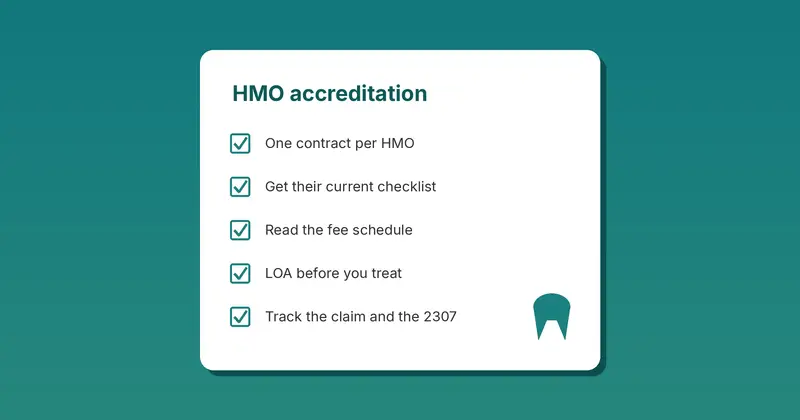
- Did we pick the HMOs our own patients already use, and ask each one for its current checklist?
- Do we have the clinic papers that checklist names, including PRC, tax and local permits?
- Did we read the fee schedule next to our own fees before signing?
- Do we know which services need an LOA, and which the card covers without one?
- On the day, do we check the name, the member number and the validity before treatment?
- Does the chart match the LOA and the claim?
- Does the HMO get an invoice from our BIR booklet, with its name, address and TIN?
- When money arrives, do we match it to the claim and ask for BIR Form 2307?
- Does our privacy notice say that an HMO receives information when a patient uses a card?
- Are we keeping our own chart for the period in P.D. 1575, even after the HMO has paid?