
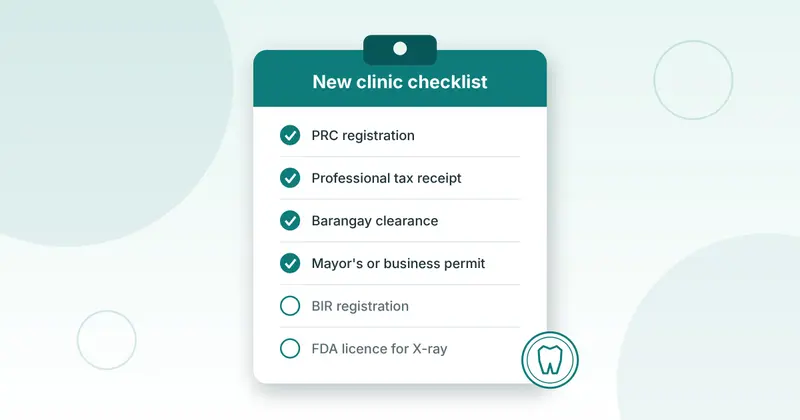
This is the list of permits and registrations a dentist usually needs to open a small private clinic in the Philippines, and the order they tend to come in. Each step names the law or the office behind it, with a link to the official page. Where the rule depends on your city or municipality, we say so: ask your LGU.
This is information, not legal or tax advice. Rules and forms change, so confirm with the office concerned before you rely on any step.
The order at a glance
- PRC registration and ID. You need these before you practice.
- Professional tax receipt (PTR) from your province or city.
- Business name, if the clinic uses one: DTI for a sole proprietor, SEC for a partnership or corporation.
- Barangay clearance where the clinic is.
- City or municipal permits: fire safety inspection, sanitary permit, and the mayor's or business permit.
- BIR registration, on or before the day you start.
- FDA authorization for your X-ray unit, before you take the first radiograph.
Then, depending on your clinic: PhilHealth accreditation, and registration with the National Privacy Commission.
Steps 5 and 6 can swap. Some LGUs and BIR offices ask to see each other's papers, so ask both before you file.
1. PRC registration and professional ID
The Philippine Dental Act of 2007, Republic Act No. 9484, defines a dentist as a person who holds a valid certificate of registration and professional identification card (Section 4). Practicing without them is an offense under Section 33.
Section 28 asks you to display your name and certificate of registration where patients can see it. If you have more than one clinic, the original goes in the main clinic and a certified copy in each branch. The owner of a clinic displays the certificates of everyone who practices there.
Your PRC ID is also on the BIR's list of documents for a PRC-regulated professional (see step 6), and the FDA asks for the PRC licenses of the dentists in an X-ray facility (step 7).
2. Professional tax receipt (PTR)
Section 139 of the Local Government Code, Republic Act No. 7160, sets an annual professional tax for each licensed professional. You pay it to the province where you practice, or where your principal office is if you practice in several places. DILG Memorandum Circular No. 2016-170 (see step 5) adds that in a highly urbanized or independent component city, you pay the city. Your LGU treasurer's office can tell you which applies.
- It is due each year on or before 31 January.
- If you start practicing after January, you pay the full year's tax before you begin.
- Once paid, Section 139(b) says you may practice anywhere in the Philippines without any other national or local tax, license or fee for the practice of the profession.
Keep the official receipt number. Section 139 asks professionals to write it on receipts, prescriptions and reports.
3. Business name: DTI or SEC
If the clinic will trade under a name other than your own, you register that name. A sole proprietor registers with the DTI. A partnership or corporation registers with the SEC.
The BIR's Form 1901 asks for the DTI certificate "if with business name". The FDA also accepts a DTI or SEC registration as proof of business name for an X-ray application. If you will practice under your own name, ask the DTI and your LGU whether you need to register a name at all.
4. Barangay clearance
Section 152(c) of RA 7160 says no city or municipality may issue a license or permit for a business or activity until the barangay where it is located has issued a clearance. The barangay must act on the application within seven working days. If it does not, the city or municipality may issue its permit anyway.
So this comes first at the LGU level. Ask your barangay hall what it needs from you; requirements vary.
5. City or municipal permits
The mayor's or business permit
This is where dental clinics are different from shops, and where LGUs differ from each other.
- DILG Memorandum Circular No. 2016-170 (28 November 2016), as reported in DILG Region V's January 2017 newsletter, says a clinic used for dental check-ups and procedures is exempt from the mayor's or business permit, if the dentist has paid the professional tax. The exemption does not cover a clinic that also runs a shop, such as one selling toothbrushes or toothpaste.
- DOF Local Finance Circular No. 001-2019 (12 June 2019), as summarized by the Department of Finance and in the BLGF's Local Treasury Operations Manual, says professionals still secure a business permit for their clinic, but at no cost. The LGU may charge a business permit fee and local business tax when the professional also sells or trades goods.
In practice, many LGUs still issue a business permit to a dental clinic, and the FDA lists the mayor's business permit as one of the accepted proofs of business name. Ask your LGU's business permits office how it treats a clinic that does treatment and sells nothing.
Fire safety inspection certificate
Under the Fire Code, Republic Act No. 9514, Section 11 penalizes a public officer who issues or renews an occupancy or business permit without a fire safety inspection certificate (FSIC) from the Bureau of Fire Protection. So if your LGU issues you a business permit, expect it to need the FSIC first. Ask the BFP station for your city or municipality.
Sanitary permit
The Code on Sanitation, Presidential Decree No. 856, requires a sanitary permit from the local health authority for several kinds of establishment, such as food establishments. We did not find a provision in it that names dental clinics. Many LGUs still ask for a sanitary permit from the city or municipal health office as part of the business permit. Check with your LGU's health office.
Your LGU may ask for other papers too, such as a zoning or occupancy clearance. The list is set locally, so ask for it in writing.
6. BIR registration
Section 236 of the Tax Code, as amended by the Ease of Paying Taxes Act, Republic Act No. 11976, says every person subject to an internal revenue tax registers once with the appropriate Revenue District Office (RDO), electronically or manually, on or before the start of business.
A self-employed dentist registers with BIR Form 1901, choosing the taxpayer type for a licensed (PRC) professional. The form's list of documents includes:
- your valid PRC ID, and a government ID or other proof of your residence or business address
- either BIR-printed invoices, or a final sample of your own invoices from an accredited printer
- your DTI certificate, if you have a business name
A partnership or corporation uses a different BIR form. Ask your RDO which applies to you. For what goes on your invoices once you are registered, see BIR invoices.
7. FDA authorization for a dental X-ray
The FDA's Center for Device Regulation, Radiation Health and Research (CDRRHR) regulates X-ray facilities. DOH Administrative Order No. 2020-0035 says a radiation facility must first secure its authorization before it uses a radiation device. Applications are filed online through the FDA website.
What you apply for depends on the unit:
| Dental X-ray unit | What the FDA issues |
|---|---|
| Periapical (intraoral) | Certificate of Facility Registration (CFR) |
| Panoramic or cephalometric | License to Operate (LTO), after a pre-licensing inspection |
| CBCT | License to Operate (LTO), after a pre-licensing inspection |
For an initial application, the AO lists:
- proof of business name: SEC or DTI registration, or the mayor's business permit
- proof of a subscription to a personal dose monitor (TLD or OSL) from an authorized dosimetry provider
- the valid PRC licenses of all the dentists and radiologic or X-ray technologists
- a certificate of training of your radiation protection officer, from an organization recognized by the CDRRHR
- a safety assessment
An initial LTO or CFR is valid for three years, and a renewal for five. The FDA's Annex D self-assessment checklist shows what an inspector looks at for each type of dental machine, such as room shielding, the red warning light and the warning sign. Several of those items do not apply to a periapical unit.
If you will not have an X-ray unit, skip this step.
Does a dental clinic need a DOH License to Operate?
Not as far as we could find, for a stand-alone clinic that does check-ups and treatment. Confirm it with your regional DOH office.
- The DOH CALABARZON licensing page lists the facilities the DOH licenses: among them hospitals, infirmaries, clinical laboratories, dental laboratories and primary care facilities. A dental clinic is not on the list.
- A dental laboratory, which makes dentures and other appliances, is licensed by the DOH (AO No. 2008-0010, on the same page).
- A primary care facility needs a DOH License to Operate under AO No. 2020-0047, and dental services can be one of its ancillary services.
- PhilHealth's own guide to Circular No. 2024-0034 says a private dental clinic will submit a DOH License to Operate if the DOH issues a policy requiring dental clinics to be licensed.
If your clinic is part of a medical clinic or offers more than dental care, the answer may be different. Ask the Regulation, Licensing and Enforcement Division (RLED) of your Center for Health Development.
PhilHealth accreditation, if you want it
PhilHealth accreditation is a choice, not a condition for opening. It matters if you want to offer PhilHealth's preventive oral health benefit under PhilHealth Circular No. 2024-0034.
PhilHealth's guide to that circular says:
- a stand-alone private dental clinic may apply, with a self-assessment, a Provider Data Record and a notarized Performance Commitment, and goes through a pre-accreditation survey
- once accredited, it makes an agreement with a Konsulta Package Provider, which refers patients to it
- a dentist applies to be accredited at the nearest Local Health Insurance Office, with a Provider Data Record, a notarized Performance Commitment and an updated PRC license
Check the current requirements with your PhilHealth office before you apply.
Data Privacy Act: NPC registration
A dental clinic keeps health information, and health information is sensitive personal information under Section 3(l) of the Data Privacy Act of 2012 (RA 10173).
Under NPC Circular No. 2022-04:
- Section 5: you must register your data processing systems if you employ 250 or more people, or process the sensitive personal information of 1,000 or more individuals, or your processing is likely to pose a risk to patients' rights and freedoms. A self-employed professional who is covered registers as an individual professional, and is treated as their own data protection officer.
- Section 6: if you are not covered and do not register voluntarily, you submit a sworn declaration instead.
- Section 7: registration is due within 20 days of starting the system or appointing the data protection officer.
A growing clinic can pass 1,000 patients sooner than you expect. Ask the National Privacy Commission which applies to you. For what the Act asks of a clinic day to day, see the Data Privacy Act. For how long to keep the records, see dental records.
A checklist to print
| Step | Office | Law or rule |
|---|---|---|
| PRC registration and ID | PRC | RA 9484, Sections 4, 28 and 33 |
| Professional tax receipt | Province or city treasurer | RA 7160, Section 139 |
| Business name, if any | DTI or SEC | BIR Form 1901 list |
| Barangay clearance | Barangay hall | RA 7160, Section 152(c) |
| Fire safety inspection certificate | BFP | RA 9514, Section 11 |
| Sanitary permit | City or municipal health office | Check with your LGU |
| Mayor's or business permit | LGU business permits office | DILG MC 2016-170; DOF LFC 001-2019 |
| BIR registration | Your RDO | RA 11976, Section 236; Form 1901 |
| X-ray CFR or LTO | FDA CDRRHR | DOH AO 2020-0035 |
| PhilHealth accreditation, if wanted | PhilHealth | PhilHealth Circular 2024-0034 |
| NPC registration or sworn declaration | NPC | NPC Circular 2022-04 |
What we could not confirm, and who to ask
- Whether your LGU asks a dental clinic for a business permit, and what it charges: your LGU's business permits office.
- Whether your LGU asks for a sanitary permit, zoning or occupancy clearance: your LGU and its health office.
- Whether you need to register a business name if you practice under your own name: the DTI and your LGU.
- Whether the DOH requires a license for your clinic, especially if it is part of a medical or primary care clinic: your regional DOH RLED.
- Whether you are covered by mandatory NPC registration: the National Privacy Commission.
- Processing times and fees for any step: the office concerned.
Once the clinic is registered, dental clinic software for the Philippines can hold the charts, appointments and bills in one place.
Dientecitos has a 30-day free trial, no card.